Recent Posts

Florence and the machinations of performative feminism

Medusa strikes back! ....unnecessarily, and at the wrong person

From Paris with love

Interview: Hitting the heart of Johnny Marr

Adventures in Modernist Melbourne

Categories
  • Architecture
  • Art
  • Film
  • Literature
  • Music
  • Travel


Tags

architecture ; art ; art exhibitions ; david sylvian ; feminism ; films ; france ; French cinema ; Hokusai ; inspiring people ; interview ; Israel ; Japanese art ; Jerusalem ; Johnny Marr ; melbourne ; modernism ; mythology ; Paris ; philippe garrel ; photography ; published works ; Robert Mapplethorpe ; travel


Archives

► November 2020
► October 2020
► August 2019
► November 2018
► February 2018
► November 2017
► October 2017

Monthly Archives: November 2020

Florence and the machinations of performative feminism

November 5, 2020

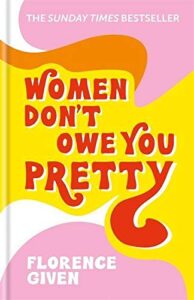
A few months ago, you couldn’t scroll through any feminist hashtag on Instagram for more than about ten seconds without seeing either the cover of, or one of the illustrated pages from, Florence Given’s Women Don’t Owe You Pretty. Off Instagram, every magazine and blog that acknowledged the book’s existence had nothing but glowing praise for it, declaring it “life-changing” among other similarly hyperbolic accolades. Naturally, I was curious as to what all the brouhaha was about, so I decided to check it out.

After reading the whole thing in barely over an hour (it might be a 200+ page book, but a good percentage of the pages are Given’s illustrations, and/or an “empowering” aphorism in 60s-style typography), I was…thoroughly unimpressed. Were it not for the instantly recognisable summer sorbet-coloured cover, I would have felt compelled to double-check that I had indeed picked up the same book all these people were raving about. I was genuinely baffled by the thought that anybody, let alone scores of people, could view Given’s rambling tome as some sort of life-changing feminist bible.

There is little actually wrong with much of the content of Women Don’t Owe You Pretty — even though the tone is oftentimes preachy, condescending or self-congratulatory. But it also doesn’t say anything new or revolutionary whatsoever; instead regurgitating basic feminist theory, combined with topics already addressed far more eloquently, and with much more depth, by other feminists on social media in recent years. Given’s own narratorial voice has all the eloquence of a nightclub toilet pep talk, except the reader doesn’t necessarily have the benefit of being under the influence to make her words sound more profound than they really are.

Considerable portions of Women Don’t Owe You Pretty deals with the concept of privilege in its various forms, and Given is all too ready to “check” her own privilege before the reader can mentally call her out on it. She’s white, thin, cisgender, able-bodied, conventionally attractive and middle class — and she’ll remind you of all those things every opportunity she gets, to the point where it begins to come across as borderline boastful, repeatedly referencing her own “prettiness” and coming out with cringe-worthy self-reflections such as “I had to acknowledge the objective fact that I sit high on society’s scale of desirability”. But simply acknowledging one’s own privilege, even in a more humble manner, and acknowledging that life is more difficult for minority groups who aren’t afforded those privileges, doesn’t make a person more capable of understanding the lived experiences of minorities. As a 21 year old with all the aforementioned privileges, and with no academic background in gender studies or sociology, what experience or authority does Florence Given actually have to address the issue of privilege as it relates to an entire gender?

It’s partly this lack of understanding of the female experience outside of Given’s own privileged existence that makes Women Don’t Owe You Pretty such an underwhelming, shallow read. But it’s also partly due to what I can only describe as Given’s sheer arrogance and self-absorption. Despite name-dropping a number of fellow feminists who represent various minority groups — women of colour, fat positivity feminists, trans activists — she never once actually seeks their input when (attempting to) cover topics such as race, fatphobia or transgender issues, nor even deigns to quote them beyond the very occasional single sentence that’s clearly placed within the text in an attempt to heighten its credibility. (The Dalai Lama and Maya Angelou are others whose words have been quoted in the same manner, though arguably even more unnecessarily.) The entirety of Women Don’t Owe You Pretty is devoted to Given’s own thoughts and advice, no matter how unqualified she is to address certain issues, lending the book’s tone a rather grating cockiness. Florence Given clearly already understands everything there is to understand about the entire spectrum of female experience, because she’s a thin, white 21 year old.

Given’s naivety when it comes to truly understanding the concept of privilege is at its most blatant when it comes to her extensive “privilege checklists” in one of the final chapters of the book. Again, the items on the checklists are basically just a collection of points raised by other feminist writers earlier, but some sections are particularly tone-deaf, where it becomes obvious that Given either hasn’t had much material to fall back on from others, or else hasn’t applied any degree of critical thinking to what she’s regurgitating. The section on male/male passing privilege is particularly rife with generalisations that completely gloss over the fact that men can also be victims of sexual violence, or objectified by women, particularly men who “sit high on society’s scale of desirability”, to use Given’s own phrasing. The disability checklist completely neglects to address either invisible disabilities or mental illness, and despite rightly accusing our society of being fatphobic in previous chapters (while of course repeatedly reminding us that she’s not a victim of that because she’s thin), there is no checklist for thin privilege at all. Unfortunately, for all the book’s emphasis on privilege and how it benefits some while harming others, Given’s sole advice for addressing this deep, systemic imbalance in society is to “consume more diverse media!”. The irony of this coming from the pages of a book written by a woman whose own privilege checklist is practically a full bingo card, while neglecting to use her platform to promote any feminists from minority groups, is not lost on me.

The occasional small nuggets of Given’s own opinions that peek through between paraphrasing the ideas of others are similarly lacking in profundity, and sometimes even alarmingly illogical or misguided. Given has a tendency to assure her readers that any “negative energy” from other people — be it somebody criticising you, or somebody simply disliking you — is without a doubt entirely due to the other person’s shortcomings. “Do you ever find yourself talking about other people to your friends and create this whole narrative in your head that they “have it in for you”, or that they hate you?” Given asks in chapter 5. “Even though you’ve had little to no communication at all? Well, they don’t hate you! You just hate yourself!”, she declares, words dripping with self-satisfaction. A comforting thought, undoubtedly, but also total poppycock. In real life, sometimes people actually will take a dislike to you for reasons completely unrelated to how much self-loathing you engage in, whether deservedly or not. To insist that any perceived dislike is a symptom of one’s own insecurity is essentially gaslighting — a topic Given addresses later on in the book, with as little depth or genuine insight as you’d expect from her by now. Continuing in this same self-soothing, accountability-shirking vein, the next chapter opens with the declaration that “the way people treat you is absolutely no reflection of you, your worth or your value”. Again, not necessarily true. While I concede that Given was presumably referring more to the “your worth or value” part of that statement, it’s again the sort of sweeping generalisation that feeds into the idea that if other people react negatively to you, it’s because of their own shortcomings, never because it might be an understandable and appropriate response to your own negative behaviours. The repeated insistence that other people only respond to you in negative ways because they’re jealous or insecure is foolish, illogical and downright harmful, because it prohibits any self-examination and acknowledgement of one’s own personality flaws — and therefore the opportunity to change.

This ego-soothing attitude in general, I suspect, is a major part of Women Don’t Owe You Pretty’s appeal. Even when it patronisingly berates you for not checking your privilege, or for your internalised misogyny, Given’s tone and choice of language always makes it feel very clear that nothing is really your fault. You’ve been brainwashed by a patriarchal society, capitalism and the male gaze — but don’t worry, Florence is here to save the day and remind you that you are a goddess, a total icon, you deserve the whole damn cake, and really, you are just incredibly amazing and special by merit of simply existing! There is nothing wrong with a bit of self-love, of course, and everybody deserves basic respect and dignity, but Given has a penchant for taking these concepts to cringe-worthy extremes. Her public persona on Instagram — although I’m sure she’d deny it was a persona of any kind, and rather her “authentic self” — is so vain that it almost makes Kanye West seem humble in comparison. Her attention-seeking narcissism is prettily repackaged as “confidence” and “self-love”, but that doesn’t change what it actually is. I have to wonder, if Florence Given isn’t putting herself on display for the male gaze, then who or what is she putting herself on display for? The female gaze? Any gaze in general? Nobody puts anything online without it being for an audience of some kind — that’s the very principle behind posting something on the internet in the first place. Nobody posts “just for themselves”, because if the content truly is just for their own self-pleasure, there’s no need for it to enter the public sphere. So if Florence Given isn’t posting her attention-seeking content for the male gaze, and by merit of it actually being online at all, it’s not just for herself, is her content possibly…gasp…capitalist marketing? But Florence hates capitalism! She’s said so repeatedly!

And yet, at the end of the day, Women Don’t Owe You Pretty is little more than the monetisation of a trending social justice issue, and the vanity project of a privileged young woman who used the groundwork of other feminist writers to launch herself into a world of wealth and fame. Women Don’t Owe You Pretty exists at the expense of giving a platform to more experienced, more articulate feminist writers, including women from minority groups. As an introductory guide to feminism, a similar — but infinitely better — volume could have been curated, utilising the voices of multiple feminist writers, from a variety of backgrounds, to give a much more genuine, well-rounded perspective on such a complex issue. But instead, publishers chose to give that sole voice to the personality they thought would be most marketable: a white, conventionally attractive young woman whose ego and self-importance compelled her to embrace the opportunity with open arms, instead of proposing, for the greater good of an entire gender, a collaborative project that would have made for a much more satisfying end product.

That, my friends, is capitalism at its finest. And feminism at its most fraudulent.

Posted in Literature
Tagged: feminism