Recent Posts

Florence and the machinations of performative feminism

Medusa strikes back! ....unnecessarily, and at the wrong person

From Paris with love

Interview: Hitting the heart of Johnny Marr

Adventures in Modernist Melbourne

Categories
  • Architecture
  • Art
  • Film
  • Literature
  • Music
  • Travel


Tags

architecture ; art ; art exhibitions ; david sylvian ; feminism ; films ; france ; French cinema ; Hokusai ; inspiring people ; interview ; Israel ; Japanese art ; Jerusalem ; Johnny Marr ; melbourne ; modernism ; mythology ; Paris ; philippe garrel ; photography ; published works ; Robert Mapplethorpe ; travel


Archives

► November 2020
► October 2020
► August 2019
► November 2018
► February 2018
► November 2017
► October 2017

All posts tagged: mythology

Medusa strikes back! ….unnecessarily, and at the wrong person

October 20, 2020

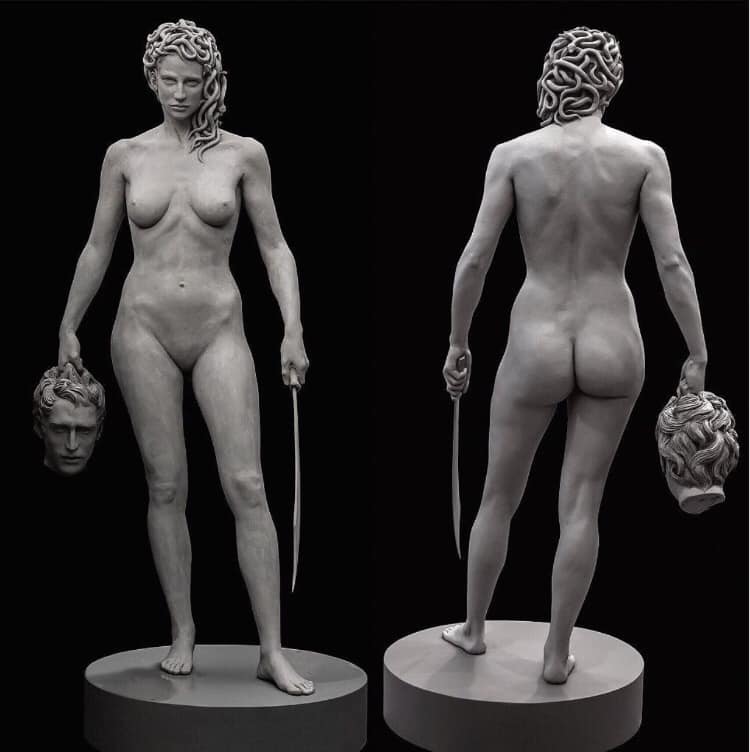
Last week, a seven foot tall bronze sculpture by Luciano Garbati, entitled Medusa With The Head of Perseus, was unveiled at a park in Lower Manhattan, to be on display for the next six months. The inverted depiction of the 16th century Florentine masterpiece, Perseus With The Head Of Medusa by Benvenuto Cellini, is claimed to portray Medusa in “a moment of somberly empowered self-defense”. It is, without doubt, intended to be a feminist statement.

At first glance, it’s easy to see why an audience might be so impressed by this work. “Hell yeah feminism, down with the patriarchy, #nastywoman, etc.” But if you’re going to use classical mythology to try to make a point about contemporary feminism and the #MeToo movement, you need to do a bit more research and a bit more critical thinking than Luciano Garbati seems to have in the process of creating this piece.

To begin with, it would seem the artist’s understanding of Medusa as a mythological character, and of Greek mythology in general, is somewhat rudimentary. Like many of the most enduring myths of Ancient Greece, there are numerous versions of Medusa’s story, and the variations begin literally from the very start. Arguably, the most commonly known version of Medusa’s origin myth is that she was originally a beautiful mortal women and only acquired her monstrous form after being cursed by Athena — but there are also versions of her story in which she was said to have always been a gorgon, thus negating the entire premise upon which Garbati’s art is based. Even following the same general branch of the Medusa myth as the artist did (ie. that she was originally a beautiful mortal woman), her being raped by Poseidon is again only one variation of the story. In some versions, Medusa and Poseidon were having a consensual affair; in others, Poseidon wasn’t even involved at all, and the reason for Medusa’s curse was her claiming to be more beautiful than Aphrodite, goddess of love and beauty. (Hubris was generally the main reason for mortals being cursed by the gods in Greek mythology, as it was considered the highest of offences to proclaim oneself superior to the gods in any way.) Furthermore, the particular translations of key phrases in early mythological literature have a very strong impact on how the myth is interpreted by modern (and even not-so-modern) readers. For example, in Ovid’s Metamorphoses, which the artist cites as their reference, the word “defiled” in relation to Poseidon’s actions towards Medusa is often used instead of “rape”, despite the latter word regularly being used elsewhere in the same text, eg. The Rape of Europa. Logically, this could lend to the conclusion that Ovid wasn’t literally describing the interaction as a rape, but rather perhaps a loss of virginity, or even simply a sex act that for one reason or another might have been deemed indecent

Regardless of how the rape or not-rape of Medusa is depicted though, the crux of the story is that Medusa wasn’t punished simply for being a rape victim; she was punished for desecrating Athena’s temple, which is not necessarily the same thing.

As for poor, newly beheaded Perseus: as far as Greek heroes go, Perseus was most definitely “one of the good guys”. The synopsis of (Garbati’s chosen interpretation of) the Medusa myth on the MWTH Project’s website conveniently neglects to mention that Perseus’ quest to behead Medusa was in fact a necessary part of a quest to save another woman, and to protect his own mother. Yet in this work, Medusa — who killed many innocent people herself as a gorgon, let us not forget — is elevated to the position of heroine, and the wrongful death of an actual hero celebrated as an act of female empowerment. Punishing an innocent man for the alleged wrongdoings of another is an act of wrath, not justice.

“Logically”, it would make more sense for Medusa to be holding the head of either Poseidon or Athena, since in several versions of the myth they’re the ones who actually wronged her. But even then, what message would that be that sending? Not only would it be sending the harmful message that violent revenge is an acceptable — nay, celebrated — response to being hurt, but given the myth’s varied narratives, it could also be argued that it sends the message that it’s okay to pick and choose whichever particular narrative suits your agenda, and use it to justify your actions, without taking into account other interpretations and possibilities.

Whether or not Medusa was actually a victim differs between versions of her myth, but as an artist, Garbati consciously makes the choice to definitively state that she is one, and that her hypothetical revenge on an innocent party — rather than on the people who victimised her — is an act of empowerment.

It’s not. Violent revenge on an entire gender is certainly not what the #MeToo movement is supposed to be about. Women are empowered by, and are actively seeking, true justice, not arbitrary punishment of men in general. Simply inverting the roles in a myth like Perseus and Medusa’s feels like a cheap attempt to cash in on the female empowerment “trend”, without putting any effort into considering the deeper meaning of choosing to work within the context of a well-known but complex myth. It feels worse than hollow: it feels exploitative. (It’s also worth noting, if you haven’t already, the presence of the male gaze in the lines of Medusa’s body. Medusa’s body was supposed to be monstrous and snake-covered too, not just her hair. So why has she been depicted here with an athletic, conventionally attractive, human female body?)

Perhaps the most tragic thing of all in this situation is that there are so many strong, powerful women in Greek mythology who could be the subject of artworks celebrating female strength and empowerment. Cyrene, Atalanta, Otrera, Antigone, Messene. Artists who want to call upon the Greek myths as a source of inspiration would do better to give a platform to the heroines that already exist in mythology, rather than trying to create a new one by butchering other myths that don’t really fit the intended message anyway.

Posted in Art
Also tagged: art, feminism